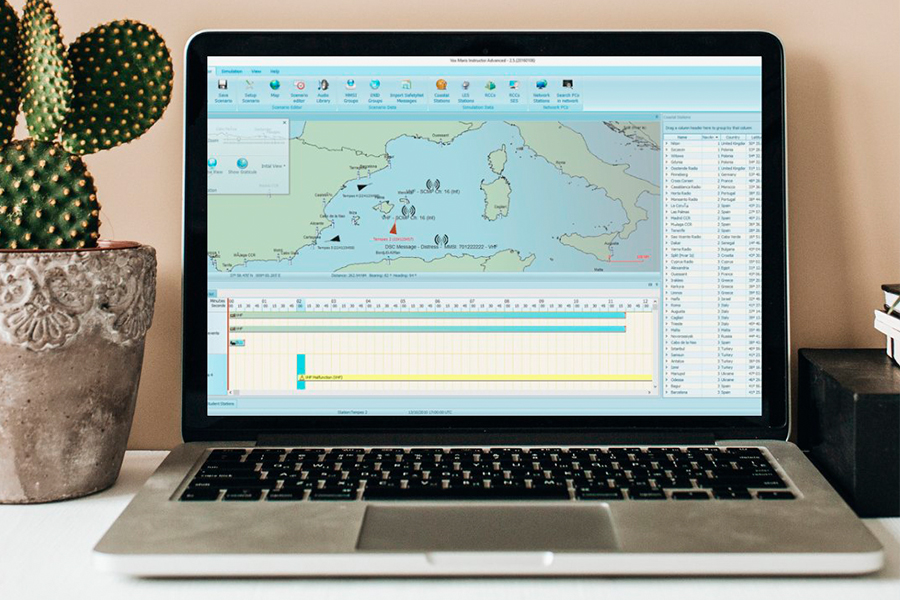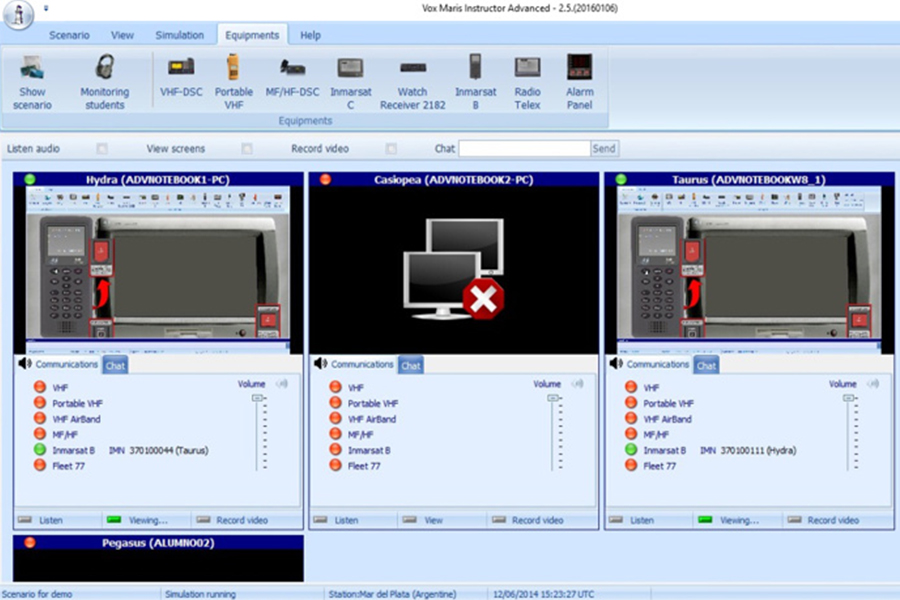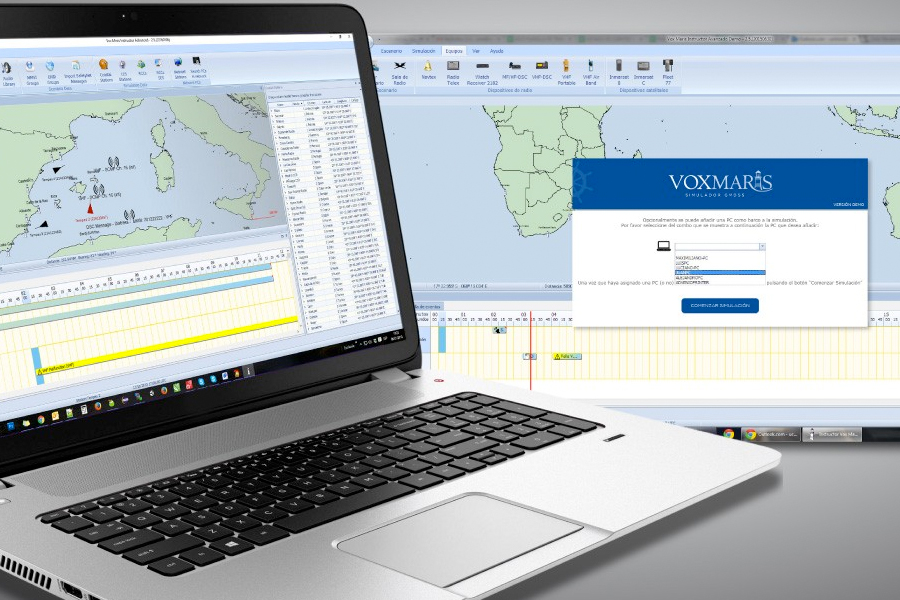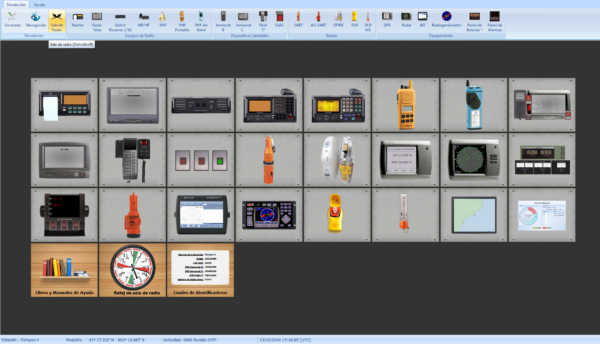
Vox Maris simulates by software the VHF/VHF-DSC GMDSS equipment.
The VHF radiotelephone totally fulfills with all the GMDSS requirements for sailing in the A1 area, accordingly to the Global Distress Maritime Security System (GMDSS).
Its operation is very simple and allows fast and efficient emergency communications, emergency or routine with other vessels. The operation and the graphical display of the equipment are simulated emulating the real equipment available in the market, achieving an unique realism by software allowing the user to operate in the same way that it would on the real equipment. Even the simulator is ready to operate with touch-screen, thereby increasing the realism achieved.
The equipment incorporates the DSC function (Digital Selective Calling) for general communications and a dedicated DSC Watch receiver for distress and safety frequencies. The DSC is a call system that allows to contact to a specific station and be aware that someone wants to contact us. In addition to calls to specific stations can also be used for calls to "all ships" and calls to groups of ships and is essential for distress signals (DSC Distress).
Among the most important simulated functions includes:
- Telephony:
- Power selector (1 W/25 W)
- Volume Control
- Automatic 16 channel button
- Automatic power reduction on 15 and 17 channels (to avoid overlapping with 16 channel)
- Automatic power reduction on 69 and 71 channels (to avoid overlapping with 70 channel)
- Squelch selector
- Channel selector
- Real time voice communications
- Dual watch
- Setup of scanner function, normal Scan or Priority Scan
- International and USA channels
- Dimmer control
- Keyboard lock
- Digital controller (DSC):
- Calls categories:
- DISTRESS
- DISTRESS RELAY
- URGENCY
- SAFETY
- Call types:
- Routine
- Individual
- All ships
- Group
- Full implementation of all ship-to-ship and ship-to-shore DSC call options
- Rx memo: Record of received communications
- Tx memo: Record of transmitted communications
- Distress automatic button
- Manual or automatic Viewing Position / Time
- MMSI numbers memory
- Acoustic Alarm Control
- Introduction manual / automatic of data
- Calls categories:
These equipment works in the range from 156 to 162 Mhz, and the frequency available has been divided in channels.
The difference between channels is about 25 Khz making 88 channels, although they are usually used from 1 to 28 and from 68 to 88.
The VHF channels are internationally recognized, having some channels a specific use:
Operation |
Channels |
Operations harbor. Tugboats |
01 - 02 - 03 - 04 - 05 - 07 - 08 - 09 - 10 - 19 - 20 |
Communications between ships |
06 |
Traffic control |
11 - 12 - 13 - 14 - 72 |
Meteorological report |
15 |
Emergency, Urgency, Security |
16 |
Radio telephony |
23 - 24 - 25 - 26 - 28 |
DSC |
70 |
Not asignated |
60 - 61 - 62 - 63 - 64 - 84 - 85 - 86 - 87 - 07 - 22 - 65 - 66 - 73 - 79 - 80 - 81 - 82 - 03 - 88 |
For transmitting it can be used 1 or 25 Watts of power. In short distances, low power must be used to
avoid interferences and channels near 16 (15 and 17) have limited their transmit power to 1 Watt in order to not make interferences on channel 16.
Channel 70 is reserved for Digital Selective Calls (DSC) within the Global Maritime Distress and Safety System (GMDSS).
The waves emitted by VHF propagates in straight line and the Earth curvature. However theses waves are interrupted by othres obstacles,
such as mountains or earth curvature. Both antennas (emitter and receiver) should be as high as possible to avoid these obstacles, and they
must have a height about1.5 to 2 mtrs. and need to be placed as high as possible.
The VHF Radiophones totally fulfill GMDSS requirements to sail in A1 Area, according to GMDSS regulations, and its operation is very simple and allows to contact in a fast and effective way to ask for aid, urgency or routine to other ships.
VHF radio equipment has built-in DSC function (Digital Selective Call) for general communications and a dedicated DSC receiver to monitor distress and security frecuencies. DSC is a call system that allows to contact to a specific station and to know if someone wants to contact us. It can also be used for calls to all ships or groups of ships and fundamentally for distress signals (DSC Distress).
.: Advantages and disadvantages :.
The very high frequency radios have the following advantages and disadvantages:
Advantages |
Disadvantages |
| Little consumption in emission and reception | Limited effective useful range (20 - 25 miles) |
| Small dimensions and weight | Expensive repairs |
| Good sound (FM) | |
| Easy instalation (battery connection and antenna) | |
| Easy use | |
There are some models provided with DW (Dual Watch) that allows to listen two different channels simultaneously.
Other devices have also a function to scan between programmed channels.
Radio communications regulations establish that ships with VHF, whenever it's possible, must keep listening in the international distress
frequency of 156.8 Mhz, (Channel 16), since it is used for urgency, distress and security signals. All Coast Stations also must maintain
permanent listening in Channel 16.
All the signals of radio are influenced by the transmission medium where it propagates, in this case the terrestrial atmosphere. These changes have to do with the capacity of ions present in the high layers of the atmosphere to absorb or to reflect the electromagnetic signals and therefore, to affect the propagation of the radio signal. As well the solid mediums interpose them, have to do with this propagation since certain frequencies and interposed material, affects the condition of communication between two radio stations. In certain conditions, the signals undergo a series of bounces between the superior layers and the terrestrial mass, causing in this way their propagation by the terraqueous surroundings Highest frequencies perforate the ionosphere and they are lost in the space or they are caught by the satellites. Meanwhile, high frequencies can even bounce in rocky surfaces like mountains, etc. and propagate by bounces as it is the case of the microwaves.
In the VHF marine band, the waves do not bounce in the high layers of the atmosphere therefore communications to very long distance cannot be made and are highly influenced by the mountainous chains or high buildings. All these concepts exert a particular importance at the time of installing the antenna.
The radio waves are not affected by the wind or rain. But these climatic factors can have influence on the antennas since the humidity or the movement causes variations in the electrical characteristics of these elements.