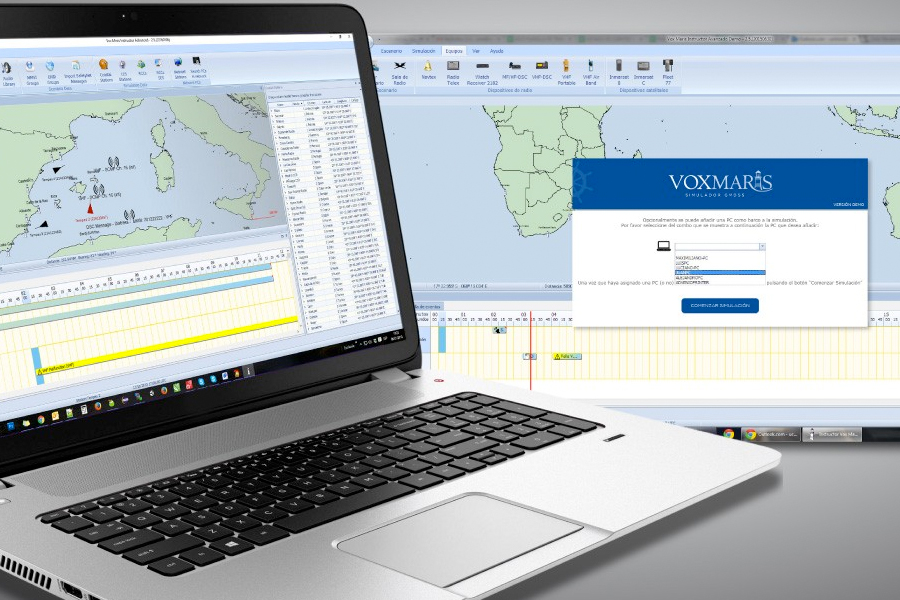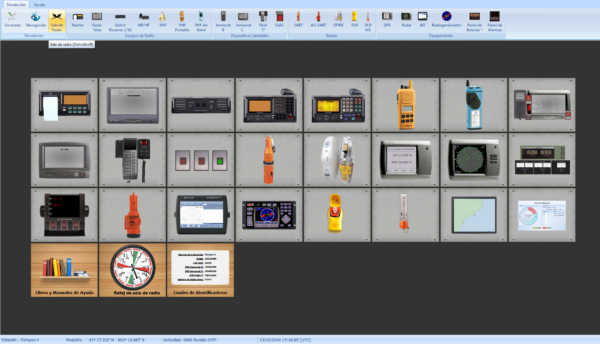
Vox Maris simulates by software a radio communications equipment of high and medium frequencies (MF/HF) that totally fulfills with the GMDSS requirements. To navigate in areas A1 and A2, according to the Global Maritime Distress and Safety System (GMDSS), a vessel over 24 m in length, must have, among others, one or more MF / HF, according to RULE 7 and 8 of Chapter IV of SOLAS.
Its operation is very simple and allows fast and efficient distress, urgency, security or routine ship-to-ship/shore/all-stations communications. The operation and the graphical display of the equipment are simulated emulating the real equipment available in the market, achieving an unique realism by software allowing the user to operate in the same way that it would on the real equipment. Even the simulator is ready to operate with touch-screen, thereby increasing the realism achieved.
Among the most important simulated functions includes:
- Telephony:
- Power selector (Hi/Med/Low)
- Volume Control
- Work mode selector (J3E/H3E)
- Squelch selector
- Channel selector
- RFG selector
- Clarity selector
- Real time voice communications
- Scanner function setup
- Dimmer Control
- Keyboard lock
- User channel setup
- Digital controller (DSC):
- Call categories:
- DISTRESS
- DISTRESS RELAY
- URGENCY
- SAFETY
- Call types:
- Routine
- Individual
- All ships
- Group
- Full implementation of all circuits of Calls of Ships and Coastal stations
- Rx memo: Record of received communications
- Tx memo: Record of transmitted communications
The equipment incorporates the DSC function (Digital Selective Calling) for general communications and a dedicated DSC Watch receiver for distress and safety frequencies in MF and HF bands.
The DSC is a call system that allows to contact to a specific station and be aware that someone wants to contact us. In addition to calls to specific stations can also be used for calls to "all ships" and calls to groups of ships and is essential for distress signals (DSC Distress).
The DSC call is directed to another station, communication following to this call are made in an appropriate radio frequency. The frequencies for calls and safety warning are DSC 2187.5 kHz, 4207.5 kHz, 6312 kHz, 8414.5 kHz, 12 577 kHz, and 16804.5 kHz. The calling frequencies for public communication with shore stations are determined by couples, both international and national frequencies are previously set. Additionally the frequency of 2177 kHz can be used for calling ship to ship.
The DSC channels may be individually selected or scan automatically all selected channels. When a DSC message is received, the radio provides audible and visual alarms.
![]()
.: Real Equipment Features :.
A MF/HF radio communication equipment works in the frequency band between the 2 - 3 MHz (MF) and also between the 3 - 30 MHz (HF or short wave) In the range of MF waves, ground wave propagation has an elevated absorption during the day and Ionospheric propagation during the night. In the range of HF frequencies, the electromagnetic waves, that propagate in line straight, bounce to different heights from the ionosphere (how much higher the frequency is, the higher it bounces), which allows that signals reach distant points and they even go around the world. Normally the AM modulation (Amplitude Modulated) and SSB (Single Side Band) superior and inferior are used.
Its transmission capacities covers long distances, without making use of expensive terrestrial facilities nor satelite infrastructure, HF is the only medium that has a world-wide communication. Range that depends on the equipment, the station of the year, hour of the day and the atmospheric conditions. The obstacles between emitter and receiver do not produce disadvantages. The weak point of these equipment is its sensitivity to atmospheric conditions.
.: Propagation Specifications :.
MF
MF Band is between the 300 kHz and the 3 MHz. It is a very used band for moderate distance transmissions (A2 area), because its cover
(100 to 140 km) is greater than the one of the VHF equipment, but is not affected by the ionospheric conditions as it happens in HF.
The range over the ocean is considerably greater than on the Earth, which makes particularly useful for sea communications.
As every low frequency, the transmission in this band is usually made by terrestrial waves, fact that limits the range of the signal,
but with the advantage that it is less susceptible to the ionospheric conditions that affect band HF.
In this band are the emergency frequencies of telephony 2182 kHz, the one for DSC communications 2187,5 kHz and the one for Navtex 518 kHz.
HF
HF Band is between the 3 and 30 MHz.
The long range propagation of the HF radio waves is possible by the fact that they "bounce" between the ionosphere the
terrestrial surface repeatedly.
This phenomenon allows global range communications with an economic equipment, although this really will depend on some conditions
propagation such as geographic location, transmission frequency, the hour of the day, the station of the year, the solar activity
and other circumstances.
The energy of high frequency broadcast by the transmitting antenna, is reflected by the atmosphere high layers where the most important of
them is called F2 layer, that is located at about 250 kilometers over the Earth. When a beam is broadcast parallel to the Earth surface
reaches this layer at about 2,000 kilometers from the transmitter, returning to Earth after was reflected to a distance of about 4,000
kilometers.
These 4,000 kilometers are the trustworthy longest jump; smaller jumps can be done by antennas with different radiation patterns that radiate
more or less upwards instead of parallelly to the ground. Short wave communications to a distance over 4 000 kilometers are possible using the
own Earth as a reflector or, still better, using the surface of the sea like mirror. Since F2 layer serves to reflect the signals towards the
Earth, their characteristics and effect on the incoming radio waves of high frequency require a deeply study.
The reflecting properties of this layer must to ionization. The air density to this height is so small that the solar radiation and specially,
the ultra-violet sun rays, are able to ionize the air, being given off free ions and electrons. The electron concentration, or "ionization gradient"
determines the reflecting properties of the layer: when this concentration is great, the layer will be able to even reflect the high frequencies
(short wavelengths) towards the Earth; when she is low, their characteristics of reflection will only limit the LF bands.
Which are then the factors that tend to increase the layer ionization degree? Evidently, everything has to do with the position of the Sun and the
amount of ultraviolet radiation emitted by the Sun. The Sun position on a point in which the reflection of incident rays takes place, depends on two
factors: the hour of the day or at night and the station of the year. The amount of ultraviolet radiation varies according to a cycle of 11 years,
called cycle of sunspots. The conditions and numbers of sunspots are published with regularity by the observatories.
The reflecting condition of the F2 layer (called Fa layer night, after emerging F1 and F2 layers) determines the frequency higher than still it
can be reflected against the ionosphere. Their properties have been studied and continue being it by stations and satellites of ionospheric
sounding.
The field of waves emitted by the transmitting antenna experiences a considerable attenuation (weakening) in its way until the listener.
The absorption of the trajectory depends on the condition of the located ionosphere layers below F2 layer and of the number of terrestrial
reflections that are necessary to reach the objective area. The fact that an inferior limit and another superior exists for each trajectory,
for each point in the time, means that the use of frequencies of the transmitters of short wave is susceptible to experience periodic changes.